Apps to learn a language by reading, compared
LingQ, Readlang, Beelinguapp and Lingible all teach through reading, but each fits a different learner. Here is which one suits your level, your device and what you want to read.
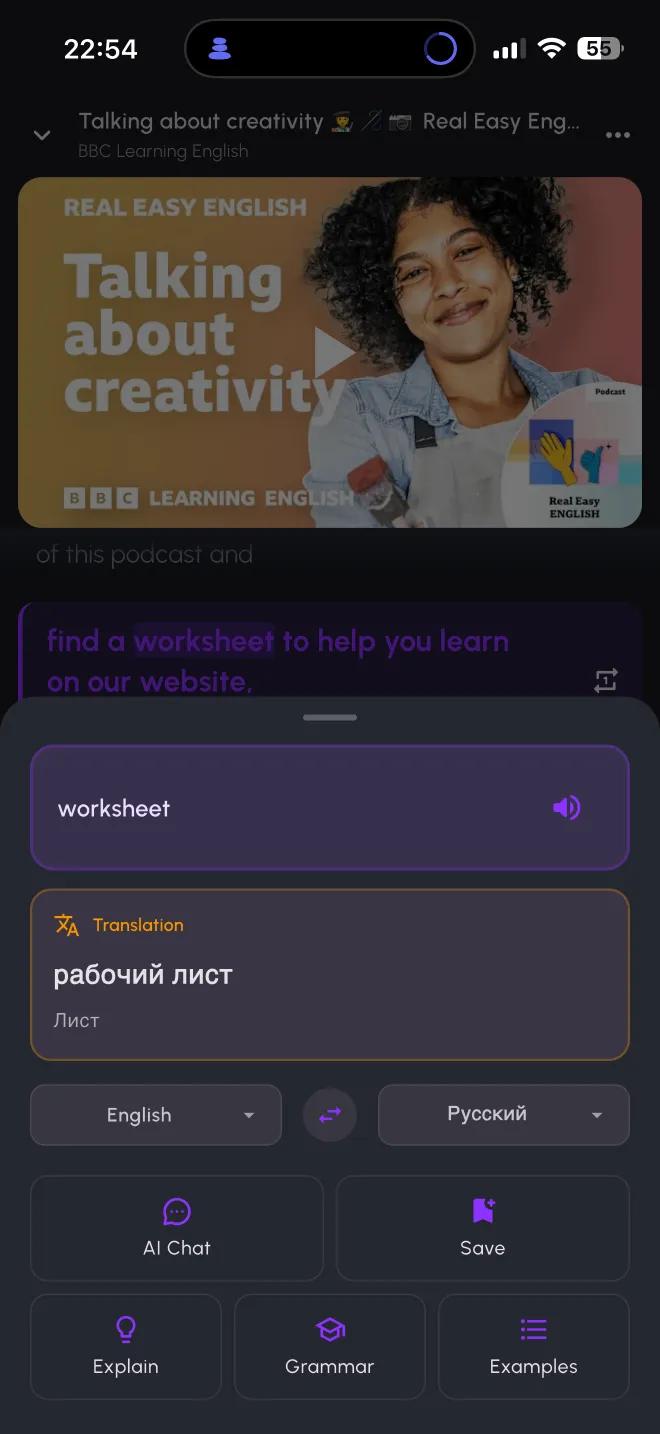
LingQ, Readlang, Beelinguapp and Lingible all teach through reading, but each fits a different learner. Here is which one suits your level, your device and what you want to read.
Reading works because you meet thousands of words in context, far more than any course can show you. An app makes it practical: it translates the word you don't know and remembers it for you. The apps below differ in what you read and how much help you get.
| Best for | What you read | Translation | Where it runs | |
|---|---|---|---|---|
| LingQ | Many languages and sources | Lesson library, imports from books, podcasts, YouTube, Netflix and more | Tap a word | Web, iOS, Android, extension |
| Readlang | Web articles on a computer | Your own texts, any web page through the extension | Click a word or phrase | Web, Chrome extension, iOS |
| Beelinguapp | Beginners | Short stories, news and songs with audio | Whole text side by side | iOS, Android |
| Lingible | Full books and YouTube on a phone | 67,000+ free books, your own EPUB or PDF, any YouTube video | Tap a word or sentence | iOS, Android |
You are a beginner (A1). Pick Beelinguapp or a structured course. Reading the original with a word lookup is too slow when every third word is new. Side-by-side text and native narration keep you moving.
You read mostly on a computer. Pick Readlang. Its browser extension turns any article you open into reading practice, and the free plan does not limit single-word translations.
You want one app for everything, or a rare language. Pick LingQ. It covers 53 languages and imports from many sources, Netflix and podcasts included.
You are around A2–B2 and want to read real books on your phone. Pick Lingible. Open a free book at your level or your own EPUB, tap only the words you miss, and review them as flashcards with the sentence they came from. The same tap translation works in YouTube with dual subtitles.
Whatever you choose, the method matters more than the app: read every day, pick texts where you know most of the words, and let context do the work instead of translating every line.
Details about LingQ, Readlang and Beelinguapp come from their own websites and store pages, checked in November 2026. Features and plans change, so check there for the current state. Prices are left out on purpose. Lingible is not affiliated with any of them.
Reading builds vocabulary and grammar intuition faster than drills once you know the basics, roughly from A2. It does not train speaking, so combine it with listening and conversation.
Simplified editions work from A2. Original novels become comfortable around B2, when you already know about 95–98% of the words on a page.
All four have a free plan with limits. Lingible's books are all free; tap translation, AI help and practice have daily limits that Lingible Pro removes.
Lingible has 60,000+ free English books, about 1,100 of them sorted by CEFR level, including simplified A2 and B1 editions.
Lingible books can be downloaded and read offline; translation needs a connection. Check the other apps' pages for their offline support.